CES lecturer wins best presentation award at ICERI 2026
Dr XU Junyu's role-play redesign of an introductory biotechnology course was recognised in Macao
Dr XU Junyu, Senior Lecturer in the Pillar of STEM Education and Associate Professor of Practice in Science Education at the College of Education Sciences (CES), has won a Best Presentation Award at the 16th International Conference of Education, Research and Innovation (ICERI 2026), held in Macao, China.
She delivered a presentation in the conference's Open Educational Resources track, titled "RPG-Based Reform of Biotechnology Introductory Course: Innovative Practice for Interest Cultivation and Ability Improvement".
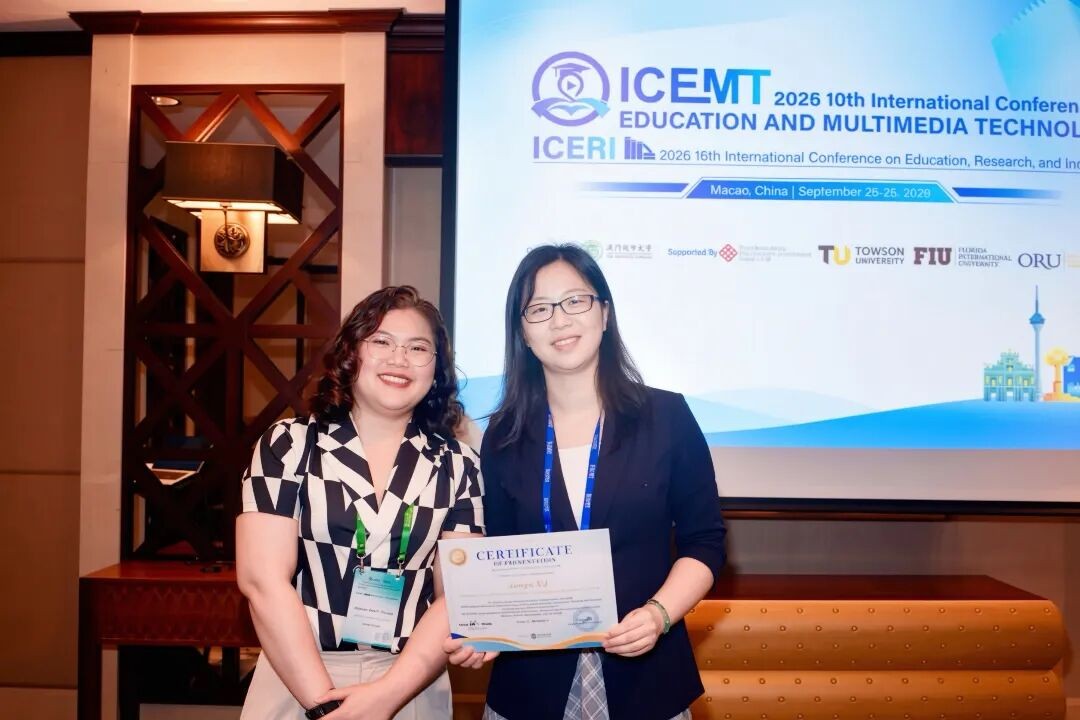
Dr XU Junyu (right) receives the Best Presentation Award at ICERI 2026 in Macao, China.
The award reflects CES's push to rethink foundation courses in a student's first two years, before a major is declared. Introduction to Biotechnology (UFUG 1403), open to engineering students, ranges across RNA technology, gene and protein engineering, cloning and stem cell technologies, immune technology, gene therapy and brain-computer interfaces.
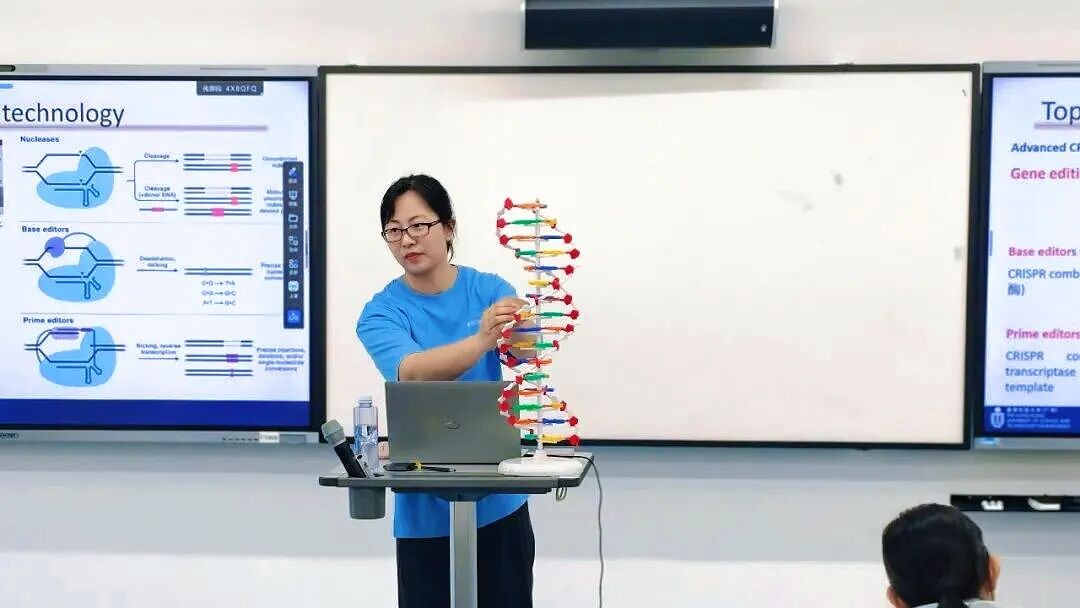
Dr XU Junyu explains gene editing with a DNA model in class.
For non-specialists, the course posed three problems: dense terminology that sapped motivation, theory that hardly met a real setting, and little practice in open-ended, ethically charged questions. Her solution was to recast it as eight storylines, one for each core module.
Students become characters in those stories — an interstellar medical team, an RNA task force, a Harry Potter trio, an island defence unit, new-era farmers, clinical gene therapists. When a fictional island is hit by an outbreak, they identify the pathogen and design diagnostic tools and treatments; when a potion is brewed wrongly, they hunt the "cursed" protein with 2-D electrophoresis and mass spectrometry, design the antidote and finally make it into a successful business.
"A game is not a gimmick," Dr Xu said. "When a game is properly integrated with course content and learning outcomes, it can be an effective way to raise students' motivation and promote knowledge transfer."
Eight online games have been built for the course, three of them already live. Each runs 10 to 15 minutes, ends with feedback tailored to the individual player, and was built for Chinese and English from the start.
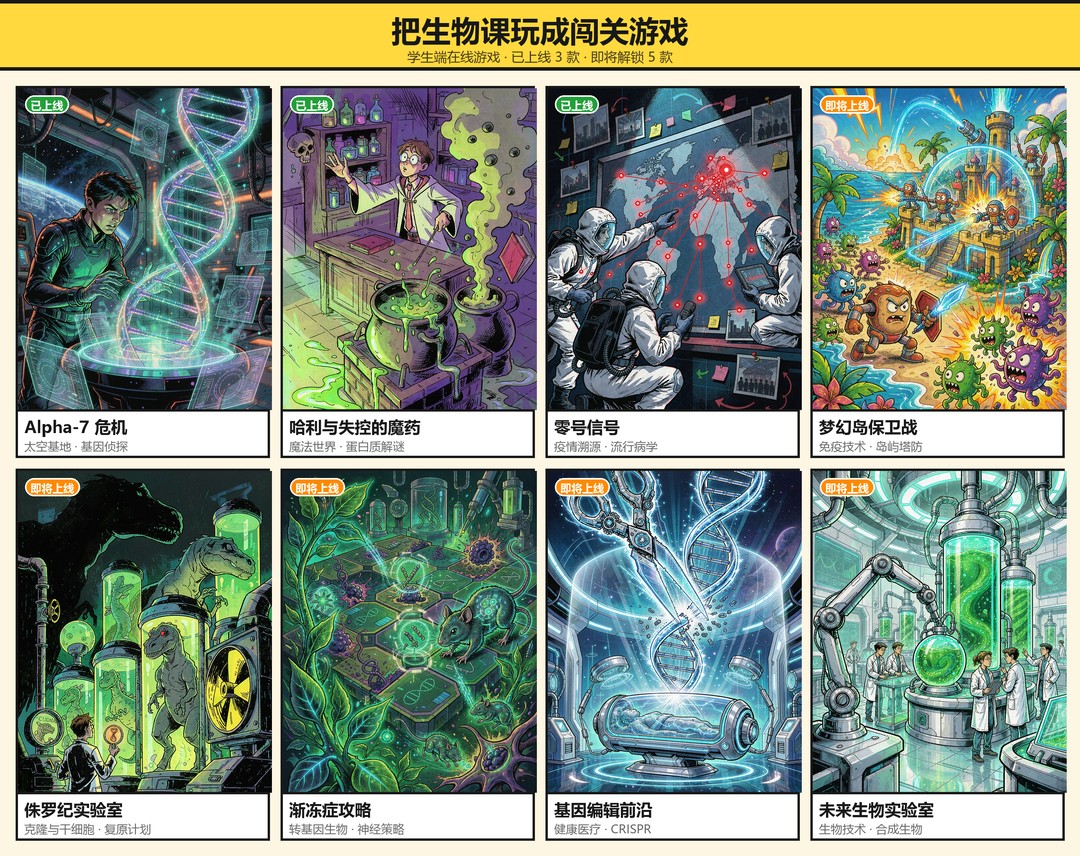
Eight game worlds have been created for the course, three of which are already online.
The reform has also drawn funding. Dr Xu's team secured a 2025 Seed Project grant from the Research on HKUST(GZ) Practices (ROP) platform, run by the University's Institute of Education Innovation and Practice (IEIP), supporting continued work on course design, teaching practice and assessment.
Next comes differentiated teaching, with roles and rotating tasks arranged so that students of different foundations each get a stretch. Dr Xu believes the framework — knowledge module, game script, role task, feedback — can travel to other courses such as physics, computer science and artificial intelligence.
The course is one of several teaching experiments at CES, which treats the undergraduate classroom as a place to ignite interest and train thinking as much as to pass on knowledge. More of the College's courses are expected to follow it onto wider stages.